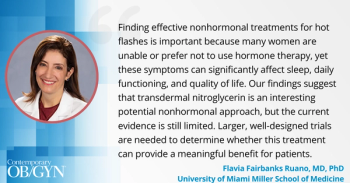

Real-world fezolinetant (Veozah) sleep data help ob-gyns counsel patients hesitant about hormone therapy, according to Marla Shapiro, CM, MDCM.
Open-ended questions help ob-gyns untangle GSM and low desire and build adherence-focused treatment plans, according to Sheryl Kingsberg, PhD.
When genitourinary syndrome of menopause (GSM) and sexual dysfunction occurred in the same postmenopausal patient, clinicians needed a biopsychosocial approach that addressed the physical and psychological components together, according to Sheryl Kingsberg, PhD. Kingsberg, chief of the Division of Behavioral Medicine at University Hospitals MacDonald Women’s Hospital/University Hospitals Cleveland Medical Center and a professor in Reproductive Biology, Urology and Psychiatry at Case Western Reserve University in Cleveland, Ohio, illustrated this approach with a case presentation at the International Menopause Society 20th World Congress on Menopause in Rio de Janeiro.
Physical symptoms were not to be ignored, but clinicians also needed to understand how the patient experienced them, Kingsberg said. That meant asking what bothered her most rather than projecting assumptions onto her. A clinician might assume her distress stemmed from frequent pain with sexual activity, when the greater concern might be an inability to have penetration at all or worry about how to discuss the problem with a partner.
The patient in Kingsberg’s case had both low desire and pain with sexual activity. Without asking, a clinician could not determine whether one was causing the other: Pain may have led to loss of interest in sex, or low desire may have led to inadequate arousal, absent lubrication, and pain. Most likely, both were present.
“If you only treated her GSM and didn’t address her low desire, that’s not going to address what’s distressing her,” Kingsberg said. Conversely, treating low desire alone would not help a patient who feared that sex would hurt every time.
Kingsberg described the overlap as the “yin and yang” of GSM and hypoactive sexual desire disorder (HSDD), the subject of a publication she coauthored in Climacteric.¹ A key mistake clinicians made when the 2 conditions overlapped was failing to ask open-ended questions. Asking what was going on and what concerns she had let a patient describe her experience, typically in less than 60 seconds.
“You’ll get a lot more information and functional information if you ask what’s going on than if you just ask yes or no questions,” Kingsberg said.
Follow-up questions could then clarify which condition was driving the other or whether both existed simultaneously, providing a clearer path to a treatment plan built on shared decision-making. A patient who participated in decisions was more invested, felt empowered, and was more likely to adhere to treatment.
Kingsberg urged ob-gyns to ask every woman at midlife, or earlier, about sexual concerns rather than only those who presented with symptoms. Sexual concerns were highly prevalent, and although many women worried that the topic was inappropriate to raise, they wanted their ob-gyn to ask.² Clinicians should not fear that asking would open a “Pandora’s box,” she said. A normalizing, open-ended prompt—noting that most midlife patients have sexual concerns and asking what concerns she has—could quickly identify pain related to GSM, HSDD, or both. Patients asked this way felt validated as sexual beings and were more likely to adhere to the resulting plan.
References