




Menopause
Latest News
Advertisement
Latest Videos






Shorts
0:25
Contemporary OB/GYN at The Menopause Society Meeting 2026
18 hours ago
by
Joshua Fitch, Senior Editor

0:40
Apply a perimenopause lens before the hot flashes start
a day ago
by
Jean Cunningham, PharmD, BCPS
1:02
The missing layer in menopausal symptom treatment
2 days ago
by
Sheryl Kingsberg, PhD

1:15
Coming soon: A new menopause series hosted by Soma Mandal, MD
14 days ago
by
Soma Mandal, MD(+1 more)

1:40
Wen Shen, MD, on history of comorbidities in perimenopause care
19 days ago
by
Wen Shen, MD(+1 more)

0:51
Perimenopause and healthy aging with Wen Shen, MD
20 days ago
by
Wen Shen, MD(+1 more)

0:48
What patients ask about perimenopause medications
a month ago
by
Jean Cunningham, PharmD, BCPS
0:21
Elinzanetant's impact irrespective of hot flash severity
3 months ago
by
Pauline Maki, PhD(+1 more)
1:41
Elinzanetant and sleep: The research questions ahead
4 months ago
by
Pauline Maki, PhD
0:30
James A. Simon, MD on bringing elinzanetant to market
4 months ago
by
James A. Simon, MD, CCD, MSCP, IF, FACOG(+1 more)
Podcasts



Advertisement
More News

ACOG issued its most comprehensive menopause guidance, grading treatments for VMS, sleep, and mood symptoms.

Get caught up with Contemporary OB/GYN! This list helps you navigate our top stories from the week, all in one place.

A recap of the top videos and podcasts from Contemporary OB/GYN in September 2026, featuring expert interviews on salpingectomy, testosterone evidence, and more.

A recap of the top headlines from Contemporary OB/GYN in September 2026, spanning ACOG's respiratory vaccine guidance to the launch of the Missed & Dismissed podcast.

A recap of Contemporary OB/GYN's top FDA and regulatory news from September 2026.

Fezolinetant was linked to VMS and sleep improvements by week 4 in the real-world OPTION-VMS study, presented at the International Menopause Society World Congress.

Wen Shen, MD, highlights perimenopause as an important period for identifying health risks and supporting healthy aging beyond the menopausal transition.

Menopause proteomics were consistently associated with inflammatory brain aging and Alzheimer’s dementia risk across nearly 15,000 women in a new study published in Nature Medicine.

Seventy-one percent of women miss their first perimenopausal symptom because anxiety, brain fog, and mood changes precede hot flashes—and most attribute them to stress, per the Bonafide 2026 State of Menopause Survey.
Get caught up with Contemporary OB/GYN! This list helps you navigate our top stories from the week, all in one place.

A new Gallup survey found 51% of women in the United States reported negative healthcare experiences.
A new study links earlier menopause age to faster cognitive decline and earlier Alzheimer diagnosis.
The FDA office of Women's Health and Center for Drug Evaluation and Research and hosting a public workshop with a focus on testosterone use in menopausal women.
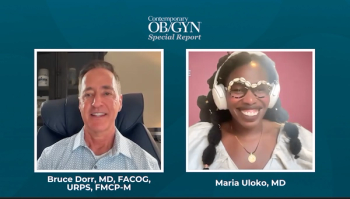
Bruce Dorr, MD, FACOG, URPS, FMCP-M, weighs his own experience with pellet therapy against guideline evidence, then he and Maria Uloko, MD, close with candid advice for clinicians too afraid of hormones to start prescribing.
Bruce Dorr, MD, FACOG, URPS, FMCP-M, and Maria Uloko, MD, walk through real-world dosing, cost workarounds, and the labs that actually matter for safety and efficacy.
Bruce Dorr, MD, FACOG, URPS, FMCP-M, and Maria Uloko, MD, reframe testosterone candidacy around clinical presentation and hormone state, not age cutoffs or a single number on a chart.
Before prescribing testosterone, know what the evidence actually proves. Maria Uloko, MD, draws a sharp line between the one population the data supports and the much wider group of women asking about it.
"Although availability of certain products or brands may vary by pharmacy or location, estradiol transdermal patches remain available," stated the federal agency in an update.

A recap of the top stories from August 2026 in women's health.
Take a look back at some of the top FDA and pipeline news in women's health from August 2026.

Peptides are highly specific signaling molecules with a heterogeneous evidence base; clinical application in women's health is most established through metabolic pathways, according to Carrie Carda, MD, MMS, MHS.

Comprehensive, trend-based hormone testing grounded in patient history offers a more complete clinical picture than isolated screening—but no panel replaces the symptom conversation, says Carrie Carda, MD, MMS, MHS.

TMP-SMX was linked to higher UTI treatment failure vs. nitrofurantoin and fosfomycin in postmenopausal women.

Get caught up with Contemporary OB/GYN! This list helps you navigate our top stories from the week, all in one place.

A new cohort study links estrogen-only MHT use to reduced Alzheimer disease pathology.
Advertisement
Advertisement
Trending on Contemporary OB/GYN
1
Before Pregnancy Begins: Why the Timing of Carrier Screening Matters
2
FDA approves first generic estradiol/levonorgestrel weekly patch
3
Executive order directs NIH to create women's health division
4
What to expect at The Menopause Society's 2026 Annual Meeting
5