
Get caught up with Contemporary OB/GYN's latest coverage from The Menopause Society Annual Meeting in San Diego, California.
Get caught up with Contemporary OB/GYN's latest coverage from The Menopause Society Annual Meeting in San Diego, California.

Misread Women’s Health Initiative data sidelined hormone therapy and menopause education, according to Mary Jane Minkin, MD, FACOG.

Susan Reed, MD, on the MsFLASH network's pooled findings, including nonhormonal therapies comparable to low-dose estradiol and CBT for sleep.

Late recurrence, high-risk features, and treatment failure can signal midlife night sweats aren’t menopause, according to Cheryl Cox Kinney, MD.

Hormone therapy was associated with more frequent, longer migraines in postmenopausal women, but not with greater severity or analgesic use.

Menopausal brain fog is common, and hormone therapy has neutral cognitive effects, according to Pauline M. Maki, PhD.

Stephanie S. Faubion, MD, on choosing between fezolinetant and elinzanetant, liver monitoring, follow-up, and open questions in menopause care.

NK receptor antagonists significantly improved sleep disturbance in menopausal women at 4, 12, and 24 weeks in a meta-analysis of RCTs.

Perimenopausal women who were more physically active had significantly lower symptom burden across all domains, a study of 1808 Flo app users found.

JoAnn V. Pinkerton, MD, MSCP, reviews 4 pooled elinzanetant analyses from OASIS presented at The Menopause Society Annual Meeting 2026, spanning late perimenopause, sleep, VMS reduction, and safety.

Distress, not low libido alone, defines HSDD, which requires a biopsychosocial evaluation, according to Holly N. Thomas, MD, MS.

Perimenopausal women over-reported total sleep time by a mean of 35.3 minutes and under-reported wake time compared with Fitbit data.

Elinzanetant cut moderate-to-severe VMS frequency by ≥50% in 66.9% of US participants compared with 40.5% on placebo.
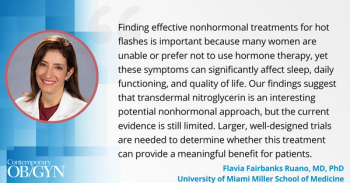
A systematic review found transdermal nitroglycerin may modestly reduce hot flashes, but evidence remains limited.
The Menopause Society's 2026 meeting in San Diego will tackle estrogen avoidance, cancer survivorship, mood, and sleep.

Fezolinetant was linked to VMS and sleep improvements by week 4 in the real-world OPTION-VMS study, presented at the International Menopause Society World Congress.

A scoping review presented at ACOG 2026 by Calbeth C. Alaribe, DMSc, MPH, PA-C, found no studies examining the association between preeclampsia, eclampsia, and endometriosis among Black women.

A recent mediation analysis shows 54% of elinzanetant's (Lynkuet) sleep benefit is independent of nighttime VMS reduction, suggesting NK1 blockade targets menopausal sleep disruption through a distinct pathway.

Experts explain the role and safety of Bayer's elinzanetant to treat vasomotor symptoms since its approval in October 2025.

A recap of the top-performing, most-viewed Contemporary OB/GYN stories from June 2026, including new SMFM guidance on acetaminophen in pregnancy, ACOG's break from federal vaccine recommendations, and our coverage of SLEEP 2026 in Baltimore.
Because only one third of nocturnal wakefulness during the menopausal transition is directly linked to hot flashes, VMS-targeted therapies alone are insufficient for many women with sleep disruption—and cognitive behavioral therapy for insomnia, supported by sleep society guidelines and accessible through free digital platforms, should be part of every clinician's sleep management toolkit, according to Pauline M. Maki, PhD.

A look ahead to the second half of 2026 for ob-gyns, including Viatris's pending FDA decision on a low-dose estrogen contraceptive patch and previews of the IDSOG, AUGS PFD Week, and The Menopause Society annual meetings.

Stephanie Faubion, MD, and Fiona Baker, PhD, discuss how elinzanetant can play a role in sleep disturbances because of VMS, emerging data on the subject, and how to determine the right candidate for the NK1-3 dual-receptor antagonist.

Nishita Pondugula, MD, MS, explains her session surrounding associations of gestational weight gain and hypertensive pregnancy disorders with prepregnancy GLP-1 exposure.

The vacuum device was favored on three measures: lower ICU admission (5% vs 12%), lower blood transfusion rates (48% vs 62%), and shorter indwelling time (by 1.96 hours), all P <.001.

SWAN data from 2066 women demonstrate that sleep disturbance has a greater independent effect on health-related quality of life than VMS alone, with the combination of both symptoms producing the most pronounced impact on physical functioning and energy—findings that support prioritizing sleep as a treatment target alongside vasomotor symptoms in menopausal care, according to Pauline M. Maki, PhD.

Research presented at ACOG suggests that gaps exist in sexual medicine education across Midwestern medical schools, potentially leading to underprepared graduates.

Eduardo Lara-Torre, MD, FACOG, emphasizes that pediatric and adolescent gynecology provides a critical bridge to ensure young patients do not lose access to care as they transition to adult providers.

Shared decision-making around nonhormonal VMS and sleep management requires moving through contraindications, patient preferences, and monitoring burdens together, with elinzanetant's (Lynkuet) dual receptor profile making it a particularly relevant option for women with both VMS and sleep disruption—and with follow-up at 2 to 3 months essential to evaluating response, according to Stephanie S. Faubion, MD, MBA, FACP, MSCP, IF.

Fiona C. Baker, PhD, explains how menopausal sleep disturbance differs from other forms of sleep disruption, citing the role of vasomotor symptoms, hormone changes, and an increased postmenopausal risk of sleep apnea in driving nighttime awakenings.