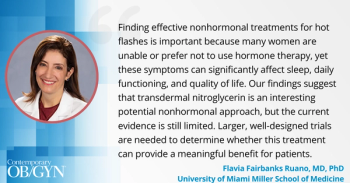
A systematic review found transdermal nitroglycerin may modestly reduce hot flashes, but evidence remains limited.
Elinzanetant cut moderate-to-severe VMS frequency by ≥50% in 66.9% of US participants compared with 40.5% on placebo.
Elinzanetant reduced moderate-to-severe vasomotor symptom (VMS) frequency by ≥50% in 66.9% of US postmenopausal participants, compared with 40.5% of those receiving placebo, from weeks 4 to 12, according to a pooled analysis of the phase 3 OASIS-1 and OASIS-2 trials presented at
VMS, also known as hot flashes, are frequently experienced during the menopause transition and can adversely affect quality of life. Elinzanetant, a dual neurokinin-targeted therapy that antagonizes the neurokinin 1 and neurokinin 3 receptors, is approved in the United States for the treatment of moderate-to-severe VMS due to menopause.
In the global OASIS-1 (NCT05042362) and OASIS-2 (NCT05099159) trials, elinzanetant significantly improved VMS frequency and severity compared with placebo, improved sleep disturbance and menopause-related quality of life, and had a favorable safety profile.
The exploratory post hoc pooled analysis assessed the magnitude of VMS frequency reduction with elinzanetant in the United States’ population of postmenopausal participants aged 40 to 65 years who experienced ≥50 moderate-to-severe VMS episodes per week. Participants were randomly assigned in a 1:1 ratio to elinzanetant 120 mg or placebo for 12 weeks, after which both groups received elinzanetant for an additional 14 weeks. Participants recorded VMS episodes in Hot Flash Daily Diaries.
Investigators calculated the proportions of participants achieving ≥50%, ≥75%, and ≥90% reductions from baseline in moderate-to-severe VMS frequency at weeks 4, 12, and 26. The ≥50% threshold was selected because it is considered clinically meaningful. A total of 410 participants in the United States were included in the full analysis set, with 205 in the elinzanetant group and 205 in the placebo-to-elinzanetant group.
From weeks 4 to 12, a higher proportion of participants in the elinzanetant group than in the placebo-to-elinzanetant group achieved each threshold:
More than half of participants in the United States treated with elinzanetant had a ≥50% reduction in moderate-to-severe VMS frequency as early as week 4. At week 4, 17.4% of participants treated with elinzanetant had achieved a ≥90% reduction, and further reductions occurred through weeks 12 and 26.
At week 26, when all participants were receiving elinzanetant, the proportions with ≥50%, ≥75%, and ≥90% reductions were comparable between the elinzanetant group (75.2%, 62.4%, and 40.4%, respectively) and the placebo-to-elinzanetant group (84.1%, 59.3%, and 39.8%, respectively).
“This pooled analysis of the OASIS-1 and OASIS-2 Phase III trials showed that from as early as wk 4, over half of the US population of participants had experienced ≥50% reduction in M/S VMS frequency with EZN, and further reductions were experienced through [weeks] 12 and 26,” wrote the authors, led by JoAnn V. Pinkerton, MD, of the University of Virginia, Charlottesville.
“These results were comparable to those observed in the overall population. EZN also demonstrated that 17.4% of participants achieved ≥90% reduction in M/S VMS frequency at [week] 4, increasing to >40% by [week] 26,” the authors concluded.
Pinkerton JV, Tough DeSapri K, Clark A, et al. Proportion of postmenopausal participants achieving ≥50% reduction in moderate-to-severe vasomotor symptom frequency with elinzanetant: pooled US population data from OASIS-1 and OASIS-2. Poster. Presented at: The Menopause Society Annual Meeting. October 20-24, 2026. San Diego, California.