

Opinion|Videos|March 25, 2025
Reducing Anxieties of IUD Placement
Author(s)Lisa Bayer, MD, MPH
Panelists discuss how physicians should empower and educate patients about intrauterine devices (IUDs) by addressing concerns directly rather than downplaying them, acknowledging pain as a legitimate issue while presenting all available options, and recognizing that IUDs are not appropriate for everyone. No patient should feel pressured to choose this method.
Advertisement
Episodes in this series
Video content above is prompted by the following:
- Physicians should explore strategies to empower and educate patients on IUDs.
- Do not downplay concerns; address them directly.
- Pain is a real concern; patients deserve to know all options.
- IUDs are not for everyone; no one should be pressured to get one.
Advertisement
Related to this article
Get caught up with Contemporary OB/GYN's latest coverage from The Menopause Society Annual Meeting in San Diego, California.

Hormone therapy was associated with more frequent, longer migraines in postmenopausal women, but not with greater severity or analgesic use.

NK receptor antagonists significantly improved sleep disturbance in menopausal women at 4, 12, and 24 weeks in a meta-analysis of RCTs.

Perimenopausal women who were more physically active had significantly lower symptom burden across all domains, a study of 1808 Flo app users found.

Perimenopausal women over-reported total sleep time by a mean of 35.3 minutes and under-reported wake time compared with Fitbit data.

Elinzanetant cut moderate-to-severe VMS frequency by ≥50% in 66.9% of US participants compared with 40.5% on placebo.
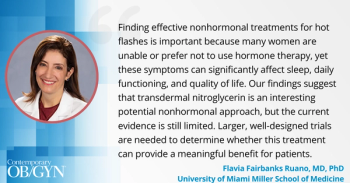
A systematic review found transdermal nitroglycerin may modestly reduce hot flashes, but evidence remains limited.
The Menopause Society's 2026 meeting in San Diego will tackle estrogen avoidance, cancer survivorship, mood, and sleep.
Advertisement
Advertisement
Trending on Contemporary OB/GYN
1
Neurokinin receptor antagonists improve menopausal sleep disturbance
2
Stephanie Faubion, MD, on the first menopause therapy discussion
3
How misread WHI data reshaped menopause care and training
4
TMS 2026: HSDD biopsychosocial approach, night sweats red flags, misread WHI data
5