

This FAQ summarizes a Special Report discussion on how two experts decide who is a candidate for testosterone therapy in women, from symptoms and context to hormone state vs age.
This FAQ summarizes a Special Report discussion on how two experts decide who is a candidate for testosterone therapy in women, from symptoms and context to hormone state vs age.
This FAQ summarizes a Special Report discussion of what the evidence does and does not establish about testosterone therapy in women.

Kanchi Chadha, MD, FACOG, MSCP, supports reconsidering MHT boxed warnings but says the FDA cited no study behind the change.

HRSA will award up to $1 million to a single organization to update the Women's Preventive Services Guidelines through the new WISH program.

Real-world data show maternal RSVpreF vaccination was 82% effective against infant RSV LRTI hospitalization through 3 months.

Soma Mandal, MD, MSCP, says removing MHT boxed warnings is overdue but calls for transparency on the FDA's product-specific rationale.
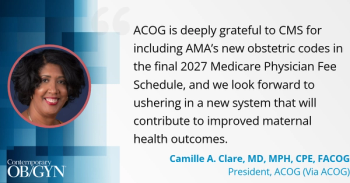
CMS' proposed G-codes, which experts stated would cause confusion in combination with the AMA's proposed codes, were not included in the final fee schedule for 2027, according to ACOG.

Matthew Nudy, MD, on estrogen's cardiovascular effects, risk assessment, and hormone therapy safety in younger menopausal women.

Samples from a large UK screening trial supported validation of the investigational Evident ovarian cancer test, according to Dawn Mattoon, PhD.
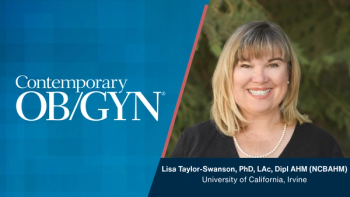
Lisa Taylor-Swanson, PhD, on a pilot in which integrative group medical visits improved menopause symptoms, knowledge, and self-efficacy.

Peter Hsin, BS, discusses a meta-analysis linking perioperative ketamine to lower early postpartum depressive symptoms after cesarean delivery.

A recap of the top video interviews from Contemporary OB/GYN's coverage of The Menopause Society 2026 Annual Meeting in San Diego.

Susan Reed, MD, MPH, MS, and Calbeth C. Alaribe, DMSc, MPH, PA-C, CPCHE, weigh in on FDA boxed warning removals for menopausal hormone therapy.

The FDA granted accelerated approval to Voceryq to reduce papilloma excision surgeries in adults with recurrent respiratory papillomatosis.

A recap of the top women's health headlines from October 2026, including FDA approval of pritelivir for refractory HSV, ACOG's new menopause guideline, and more.

Chrisandra Shufelt, MD, on using a cardiovascular risk score to guide hormone therapy candidacy at menopause.

The October 30 update from the FDA follows the February 12, 2026 labeling changes to 6 menopausal hormone therapy products in which the agency also removed safety-related boxed warnings.

Neither maternal MOUD dose nor umbilical cord opioid levels were associated with neonatal opioid withdrawal syndrome severity.

Susan Reed, MD, on the need for menopause research funding, a clinical trials network, and studies in understudied groups and perimenopause.
Chrisandra Shufelt, MD, on why menopause is a window for cardiovascular prevention and the risk factors OB/GYNs should assess.

ACOG advises against GLP-1 receptor agonists in pregnancy and recommends considering discontinuation 1 to 2 months before conception.

Rhonda Voskuhl, MD, on a case series in which estriol and progesterone improved self-reported cognition in menopausal women at 12 months.

Joint guidance from the AHA, AAP, ACOG, and SMFM organizes cardiovascular prevention for girls and women around 4 female life stages.

In the premiere episode of Mind, Body, & the Pause, Soma Mandal, MD, is joined by Manisha Parulekar, MD, and Jocelyn Carlo, MD, FACOG, to discuss the stages of the menopause transition.

Jessica Shepherd, MD, MBA, FACOG, joins Missed & Dismissed to discuss why perimenopause is overlooked and how disparities shape who gets care.
Get caught up with Contemporary OB/GYN's latest coverage from The Menopause Society Annual Meeting in San Diego, California.

Misread Women’s Health Initiative data sidelined hormone therapy and menopause education, according to Mary Jane Minkin, MD, FACOG.
Susan Reed, MD, on the MsFLASH network's pooled findings, including nonhormonal therapies comparable to low-dose estradiol and CBT for sleep.

Late recurrence, high-risk features, and treatment failure can signal midlife night sweats aren’t menopause, according to Cheryl Cox Kinney, MD.

Hormone therapy was associated with more frequent, longer migraines in postmenopausal women, but not with greater severity or analgesic use.