






A pending prospective, multi-center study will assess whether mothers with cystic fibrosis can maintain their health if they become pregnant.
A pending prospective, multi-center study will assess whether mothers with cystic fibrosis can maintain their health if they become pregnant.

A qualitative study in the Journal of Racial and Ethnic Health Disparities has concluded that ethnic and racial considerations can have significant impact on patient experience of uterine fibroid (UF) diagnosis and management.

Fibroid uterus cases with anemia in premenopausal women are more likely to have vitamin D deficiency as compared to cases without anemia, according to a study from India in the journal Cureus.

A prospective study has concluded that women of childbearing age with uterine fibroids (UF) who desire to preserve fertility benefit from the combined oral supplementation of vitamin D, epigallocatechin gallate (EGCG) and vitamin B6.

Senior editor Angie DeRosa interviewed Sateria Venable, Founder & CEO of the Fibroid Foundation, and Ayman Al-Hendy, MD, a professor of ob/gyn at the University of Chicago Medical Center, about patient-physician collaboration when it comes to addressing uterine fibroids.

Contemporary OB/GYN®’s senior editor Angie DeRosa sat down with Ayman Al-Hendy, MD, and Sateria Venable of The Fibroid Foundation, to discuss the role of patient-physician collaboration in uterine fibroid treatment and management options.
Transcervical fibroid ablation (TFA) to treat symptomatic uterine fibroids (UFs) is effective for a wide range of fibroid types and sizes, according to preliminary results of the first 160 women treated in the Transcervical Radiofrequency Ablation of Uterine Fibroids Global Registry (SAGE registry).

As there is a higher rate of uterine fibroids among Black women, researchers seek to find the cause.

The COMPARE-UF Experience provides relevant information for patients and their providers in choosing a surgical treatment for uterine fibroid (UF) symptoms.
“New studies are showing significantly increased risks of cardiovascular disease, weight gain and mood disorders, even with bilateral ovarian conservation,” Elizabeth A. Stewart, MD, told Contemporary OB/GYN.

When it comes to diagnosing women with uterine fibroids (UFs), no single patient, fibroid or lived experience is the same, according to Sony Sukhbir Singh, MD, a professor of gynecology at the University of Ottawa and The Ottawa Hospital in Ontario, Canada.

A better understanding of the pathophysiology of uterine fibroids (UFs) will enable healthcare providers to deliver high-quality informed care to their patients, according to Ayman Al-Hendy, MD, PhD, a professor of ob/gyn at Pritzker School of Medicine, University of Chicago.
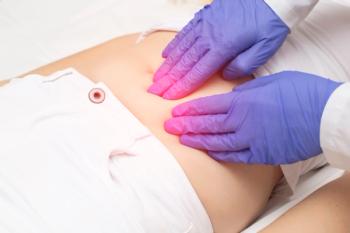
The two most common symptomatic types of uterine fibroids (UFs) are intramural and subserosal, according to an unpublished study from Jordan.
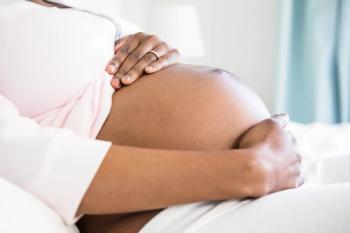
A study in the Journal of Maternal-Fetal and Neonatal Medicine found that the combination of a cervical procedure and vaginal micronized progesterone helped achieve term deliveries in more than 90% of pregnant women with large uterine fibroids (UFs).
Black women are more likely to undergo uterine fibroid (UF) treatments that are uterine-sparing compared with their White counterparts, according to a prospective cohort study in the Journal of Women’s Health.
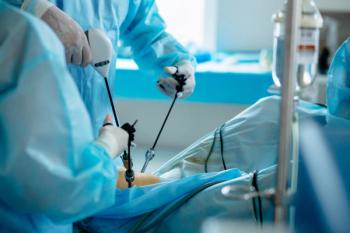
A retrospective study in the journal Obstetrics & Gynecology and Reproductive Health has concluded that total laparoscopic retrograde hysterectomy (TLreH) for severe endometriosis with obliterated cul-de-sac is both feasible and safe.
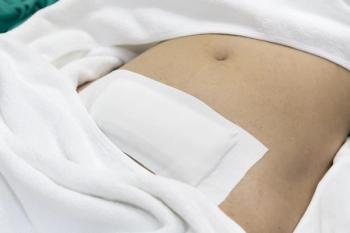
Women with submucosal uterine leiomyomas who undergo hysteroscopic removal have comparable birth outcomes to women with submucosal uterine leiomyomas who do not have hysteroscopic removal, according to a retrospective case-control study in the American Journal of Obstetrics & Gynecology MFM.
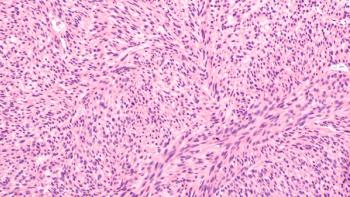
High signal intensity on T1-weighted magnetic resonance images (MRI) and low diffusion coefficient values can accurately differentiate uterine leiomyosarcoma from benign leiomyoma, according to a meta-analysis in the Journal of the Belgium Society of Radiology.
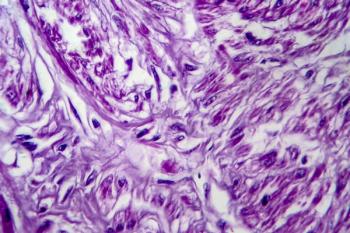
A small clinical trial has found that transvaginal high-intensity focused ultrasound (vHIFU) is a promising treatment for women with symptomatic uterine leiomyomas.

Because obstructive uropathy due to gynecologic benignities is an extremely rare, difficult, and challenging life-threatening condition, physicians should always consider the existence of uropathy.
“There is a large unmet need in the uterine fibroid space for noninvasive treatment options,” said Ayman Al-Hendy, MD, Ph.D., lead author of the analysis and a professor of ob/gyn at The University of Chicago.
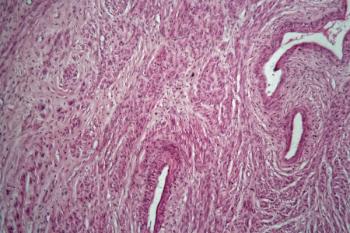
Study results, which were published in the European Journal of Obstetrics & Gynecology and Reproductive Biology, also found the drug well tolerated.
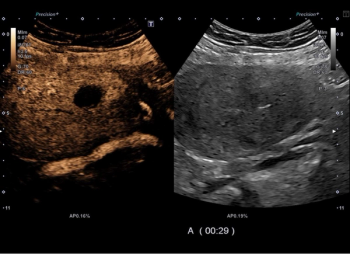
A prospective observational study in the Journal of Ultrasound in Medicine has concluded that for pretreatment evaluation of uterine fibroids (UF), transabdominal contrast-enhanced ultrasound (CEUS) represents a viable alternative to traditional contrast-enhanced magnetic resonance imaging (MRI).
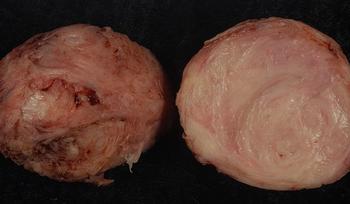
Although myomectomy may prolong the operative time and the postoperative hospital stay, there are numerous potential benefits including avoiding a follow-up operation to remove uterine fibroids.

High-intensity focused ultrasound (HIFU) for the treatment of uterine fibroids may not significantly increase the risk of pelvic adhesions.