
News|Videos|August 11, 2023
EP. 5: OAB Treatment: Available Strategies and Rationale for Use
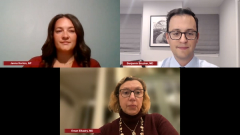
Panelists introduce the available treatment modalities for OAB, including behavioral modification, pharmacologic treatment, neuromodulation, and surgical approaches.
Advertisement
Please see full
Sponsored by AbbVie US Medical Affairs
Episodes in this series

This content is intended for US/PR Healthcare Professionals.
The Medical Affairs department of AbbVie Inc. is the sole author and copyright owner of this presentation and has paid Urology Times to host this presentation. AbbVie is solely responsible for all written and oral content within this presentation. © 2023 AbbVie Inc. All rights reserved.
Advertisement
Related to this article

Neither maternal MOUD dose nor umbilical cord opioid levels were associated with neonatal opioid withdrawal syndrome severity.

Susan Reed, MD, on the need for menopause research funding, a clinical trials network, and studies in understudied groups and perimenopause.

Chrisandra Shufelt, MD, on why menopause is a window for cardiovascular prevention and the risk factors OB/GYNs should assess.

Matthew Nudy, MD, on estrogen's cardiovascular effects, risk assessment, and hormone therapy safety in younger menopausal women.

ACOG advises against GLP-1 receptor agonists in pregnancy and recommends considering discontinuation 1 to 2 months before conception.

Rhonda Voskuhl, MD, on a case series in which estriol and progesterone improved self-reported cognition in menopausal women at 12 months.

Joint guidance from the AHA, AAP, ACOG, and SMFM organizes cardiovascular prevention for girls and women around 4 female life stages.

In the premiere episode of Mind, Body, & the Pause, Soma Mandal, MD, is joined by Manisha Parulekar, MD, and Jocelyn Carlo, MD, FACOG, to discuss the stages of the menopause transition.
Advertisement
Advertisement
Trending on Contemporary OB/GYN
1
ACOG advises against GLP-1 receptor agonists during pregnancy
2
Safety Monitoring and Dosing for NK3 Antagonists in Menopause VMS
3
Susan Reed, MD, on the future of menopause research and funding
4
Matthew Nudy, MD, on estrogen and the cardiovascular system
5