
Dysplastic Ichthyosis Uteri-like Changes of the Entire Endometrium Associated with a Squamous Cell Carcinoma of the Uterine Cervix
Dysplastic Ichthyosis Uteri-like Changes of the Entire Endometrium Associated with a Squamous Cell Carcinoma of the Uterine Cervix
The first vaccine to prevent human papillomavirus (HPV) and cervical cancer has been licensed, and in future, vaccination may be routinely offered to 10–14 year old girls. HPV is a sexually transmitted virus and some parents may refuse consent for vaccination.
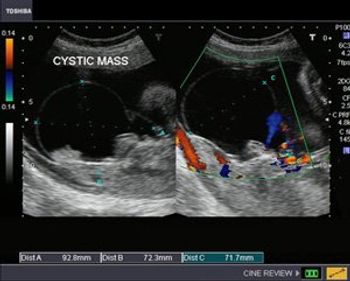
This case study shows a 26 week gestation with a cystic mass close to the sacrum.
Download the .PPT version of this presentation for off line viewing (1.92 MB)Return to Power Point Presentations Indexsubmit your own material for publication via email with your files attached
A recent study on sleep disturbances in menopause shows a direct connection to the use of hormone therapy. Specifically, when women stop taking hormone therapy they experienced greater periods of poor sleep, waking up during the night, difficulty falling asleep, waking up to early and not feeling rested.
According to results from a new study, a popular herbal remedy may come to the rescue of women suffering from postmenopausal sleep disturbances. About half of postmenopausal women experience some degree of sleep disturbance, which in turn impacts their quality of life.
Cessation of hormone therapy in menopausal women may result in sleep disturbances, according to a new study in Menopause. Since the hormone therapy has been associated with the alleviation of sleep problems in women experiencing menopausal symptoms, Dr Sarah E Tom, Interdisciplinary Women’s Health Research (IWHR) Scholar at the University of Texas Medical School, and colleagues sought to determine the resulting sleep effects during cessation of hormone therapy.
Since their introduction, cervical cytology screening programs have caused a substantial reduction in cervical cancer rates. However, the low sensitivity of one screen and resulting need for repeated screens during a lifetime to achieve programmatic sensitivity has deemed it inefficient. With that in mind, Dr Philip E Castle, of the American Society for Clinical Pathology in Washington, D.C., and colleagues compared the performance of the cobas human papillomavirus (HPV) test versus liquid-based cytology.
Physicians refer many women at average risk of ovarian cancer for genetic counseling or testing for the BRCA 1 and 2 genes while neglecting to refer many high-risk women, researchers reported in the July 25 online edition of Cancer.

Significance of the umbilical cord: the umbilical cord can be aptly termed the life line for the fetus during its intrauterine life but can often be the cause for its misery in case of cord pathology.

ACOG has recently released “Thromboembolism in Pregnancy” in the September 2011 issue of 'Obstetrics & Gynecology' to guide clinicians in the prevention, management and treatment of blood clots during pregnancy.

Accurate diagnosis of uterine fibroids is essential in deciding if treatment is necessary, and planning appropriate treatment.n While a physical exam may suggest fibroids, other conditions such as ovarian cysts or adenomyosis may be mistaken for fibroids. For this reason, I routinely do an ultrasound examination at the time of the first visit when a woman has symptoms of abnormal bleeding or cramping, or if I feel an abnormality on examination.
OBGYN.net Conference CoverageFrom American Association of Reproductive Medicine55th Annual Meeting of ASRM held conjointly with CFAS- Toronto, Ontario, Canada - September, 1999
Maternal use of opioid analgesics just prior to, or during the first trimester of, pregnancy increases the risk for certain congenital heart defects among offspring.
Although overall impact on bone is small and depends largely on age and dose, data suggest that by about 2 years of use, teens who use oral contraceptives show about 1% less gain in bone mineral density than teens who do not use the pills.
The overall birth count and fertility rate in the US declined in 2010.
Breast cancer screening with mammography should start at age 40 years and should occur annually after this, according to new guidelines.
In women with normal thyroid function, the presence of thyroid autoantibodies is associated with a more than tripled risk for miscarriage and a doubled risk for preterm birth, according to findings of a systematic review.
The process of parturition, both term and preterm, involves a uniquely coordinated interaction between the cervix and uterus.
Two US Supreme Court rulings could have wide-reaching effects on physicians who prescribe drugs and the patients who take them.
In this letter to the editor, the author discusses how physicians have lost their ability to individualize care.
The author discusses the American Board of Medical Specialties' recognition of female pelvic medicine and reconstructive surgery as a subspecialty in obstetrics and gynecology.
In a time when repeat cesarean deliveries are becoming more frequent, it can be difficult to deliver an infant when the vertex is floating high out of the pelvis.
The incidence of many types of cancer increases with increasing adult heigh, according to findings of a recent study.
Trimethoprim-sulfamethoxazole 480 mg once daily is more effective than cranberry capsules 500 mg twice daily for the prevention of recurrent urinary tract infection in premenopausal women, but it exacerbates the problem of emerging antibiotic resistance.
Women who have difficulty breastfeeding in the first 2 weeks after giving birth are about twice as likely to experience depression at 2 months postpartum, according to study findings.
Nearly 50% of sexually transmitted infections occur in adolescents and young adults between 15 and 24 years of age.
A Pennsylvania woman pregnant with twins went to a hospital for induction of labor at term. Her infant was born, having a seizure 2 hours after birth. He was diagnosed with cerebral palsy and is now fed via tube.
An advisory panel to the CDC recommends that physicians administer the tetanus diphtheria acellular pertussis vaccine to pregnant women after 20 weeks' gestation.