Now Playing
Before prescribing testosterone, know what the evidence actually proves. Maria Uloko, MD, draws a sharp line between the one population the data supports and the much wider group of women asking about it.
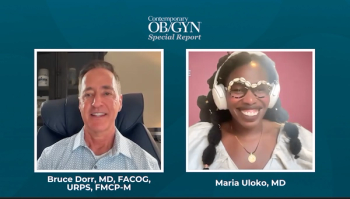
Welcome back to another Contemporary OB/GYN Special Report series! In this episode, Bruce Dorr, MD, FACOG, URPS, FMCP-M, discusses testosterone therapy in women with Maria Uloko, MD.
Dorr opens this series by introducing himself as a board-certified ob-gyn who subspecialized in urogynecology, followed by fellowship-level work in hormone replacement and functional medicine, and welcomes Uloko, a board-certified urologist specializing in comprehensive sexual health across genders, to the conversation. Dorr frames the episode's central question: Once social media noise, clinical anecdote, and personal bias are stripped away, what does the highest-quality evidence actually establish about testosterone therapy in women, and just as importantly, what does it not establish?
Uloko answers directly, noting an important caveat first: The existing evidence base, although real, remains incomplete and continues to grow. Within that evidence, she explains, the clearest signal points to one population: postmenopausal women experiencing low sexual desire, who show measurable improvement in sexual function with testosterone therapy. She is equally clear about the limits of that evidence: The data do not show a statistically significant improvement in sexual function for premenopausal women, and they do not demonstrate musculoskeletal or cognitive benefits for postmenopausal patients along the broader spectrum of testosterone use. In her words, testosterone currently holds a fairly narrow, evidence-supported indication: postmenopausal patients presenting with low desire.
Dorr acknowledges the practical tension this creates. An evidence gap, he notes, does not necessarily mean women outside the studied population receive no benefit; it means clinicians are often navigating decisions the literature has not yet fully mapped. That tension sets up the rest of the discussion, as the 2 clinicians move from what the studies show to how they apply that evidence, and its limits, with real patients in the exam room.
In the next episode, Uloko turns the conversation to the exam room, asking Dorr how he decides who is actually a candidate for testosterone when the patients walking through his door extend well beyond the guideline-backed population.