

Opinion|Videos|September 9, 2026
Improving Shared Decision-Making in Endometriosis Care
In "Improving Shared Decision-Making in Endometriosis Care," the panel opens Section 3 by asking why medical management still lags in everyday practice.
Advertisement
Episodes in this series
In "Improving Shared Decision-Making in Endometriosis Care," the panel opens Section 3 by asking why medical management still lags in everyday practice.
Dr. Davitt explains why medical management of endometriosis remains underutilized among general OBGYNs, primary care providers, and nurse practitioners. He traces it back to the same core issue discussed earlier in the series: without comfort reaching a clinical diagnosis, there is little room to progress toward more robust medical management. As more providers become familiar with the newer ACOG recommendations permitting a clinical diagnosis, he expects that recognition to translate directly into conversations about medical therapy, so primary care providers can feel confident diagnosing, recommending treatment, and following patients to ensure they achieve the results they deserve. Dr. Kho then turns to the most common misconceptions patients hold about medical and hormonal management. Many patients arrive reluctant to take any hormones or medications at all, and addressing that resistance starts with explaining what endometriosis actually is and why hormonal treatment makes physiologic sense, which the panel says often builds enough understanding to increase a patient's willingness to try medical therapy. Dr. Lukes notes the disease can persist across a woman's entire reproductive years, making timely intervention essential even as the balance between medication and surgery continues to shift. Dr. Davitt then describes his approach to shared decision-making with patients who have waited years for a diagnosis. He starts by listening fully to a patient's story, including any past dismissal, since many patients hesitate because medical therapy was once offered as their only option and felt like their symptoms were being brushed aside. He acknowledges upfront that treatment may involve some trial and learning, and commits to staying with the patient through the process regardless of early setbacks. In the panel’s closing thoughts, they call this an exciting time in women's health given advances in diagnosis, and hope the discussion encourages more providers to engage earlier with patients experiencing pelvic pain.
Thank you for watching this Contemporary OB/GYN Peer Exchange series on endometriosis. Please subscribe to our eNewsletter for information on upcoming video series.
Advertisement
Related to this article
Get caught up with Contemporary OB/GYN's latest coverage from The Menopause Society Annual Meeting in San Diego, California.

Hormone therapy was associated with more frequent, longer migraines in postmenopausal women, but not with greater severity or analgesic use.

NK receptor antagonists significantly improved sleep disturbance in menopausal women at 4, 12, and 24 weeks in a meta-analysis of RCTs.

Perimenopausal women who were more physically active had significantly lower symptom burden across all domains, a study of 1808 Flo app users found.

Perimenopausal women over-reported total sleep time by a mean of 35.3 minutes and under-reported wake time compared with Fitbit data.

Elinzanetant cut moderate-to-severe VMS frequency by ≥50% in 66.9% of US participants compared with 40.5% on placebo.
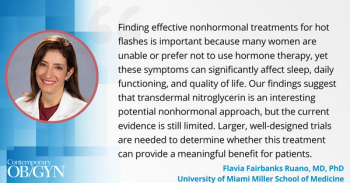
A systematic review found transdermal nitroglycerin may modestly reduce hot flashes, but evidence remains limited.
The Menopause Society's 2026 meeting in San Diego will tackle estrogen avoidance, cancer survivorship, mood, and sleep.
Advertisement
Advertisement
Trending on Contemporary OB/GYN
1
Neurokinin receptor antagonists improve menopausal sleep disturbance
2
TMS 2026: HSDD biopsychosocial approach, night sweats red flags, misread WHI data
3
How misread WHI data reshaped menopause care and training
4
Stephanie Faubion, MD, on the first menopause therapy discussion
5